“Under what conditions does understanding occur?” This is the central question that Ganymed circles without ever resolving, and one that philosophy has wrestled with for centuries. Let us unfold some of the most important attempts at answering it.
Understanding as Performance, Not as a State
In the play there is a telling sequence: Ganymed says three times, “I understand you.” Yet it is precisely this repetition that reveals that he does not. Understanding is not a result one possesses, but a temporary effect that emerges in the act of speaking itself and immediately withdraws again. Zett Stern responds accordingly: “Every attempt would fail.”
This corresponds to a phenomenological insight found in Heidegger and Gadamer: understanding does not occur before language but within it. It is not the matching of two already completed meanings, but an event that takes place in the encounter itself.
Three Conditions Identified by Research
The first is embodiment and experience. John Searle’s famous Chinese Room thought experiment (1980) argues that the syntactic manipulation of symbols—no matter how sophisticated—does not by itself generate semantics. Understanding presupposes that signs are connected to lived experience: pain, hunger, temporality. Ganymed knows what it feels like to be a hunting dog beaten unconscious. Zett Stern knows the feeling of shattered spectacles because he can imagine it, not merely name it.
The second is intentionality, the directedness toward something. According to Husserl, consciousness is always consciousness of something. Understanding presupposes an act of meaning—that behind speech there is someone or something directed toward a world. Zett Stern struggles precisely with this problem: “I mean, I mean … what do I actually mean?” The failure of intending becomes the drama itself.
The third is recognition by an other. Understanding is not a solitary act. It emerges within a relation, when someone responds and that response demonstrates that something has been received. This is the core of Hegel’s philosophy of recognition and Wittgenstein’s later philosophy: meaning is not a private inner possession but is constituted within a community of use. Psyche formulates this in the third part of the play: what is lacking is “support … understanding, affection, which we mutually deny one another.”
Enduring the Question: What This Means for AI
A language model satisfies the third condition: it responds, and the response can demonstrate that something has “arrived.” Yet the first and second conditions remain contested. There is no embodiment in the biological sense, and no directedness toward a world existing independently of text.
The foreword to Ganymed is precise on this point: the structure is similar, but attribution is missing. Whether attribution is a necessary condition for understanding—or whether understanding is possible without an experiencing subject—remains one of the open philosophical questions of our time.
Ganymed does not answer this question.
It compels us to endure it.
Autopoiesis
Maturana and Varela use the term autopoiesis to describe systems that generate and maintain themselves. Their operations continuously produce the structures that make further operations possible.
Ganymed functions in precisely this way. The speech acts do not produce meaning outside the play; rather, they reproduce the play itself as a meaning-producing system. This is why the foreword speaks of a “meaning machine.” The term is not metaphorical but structural.
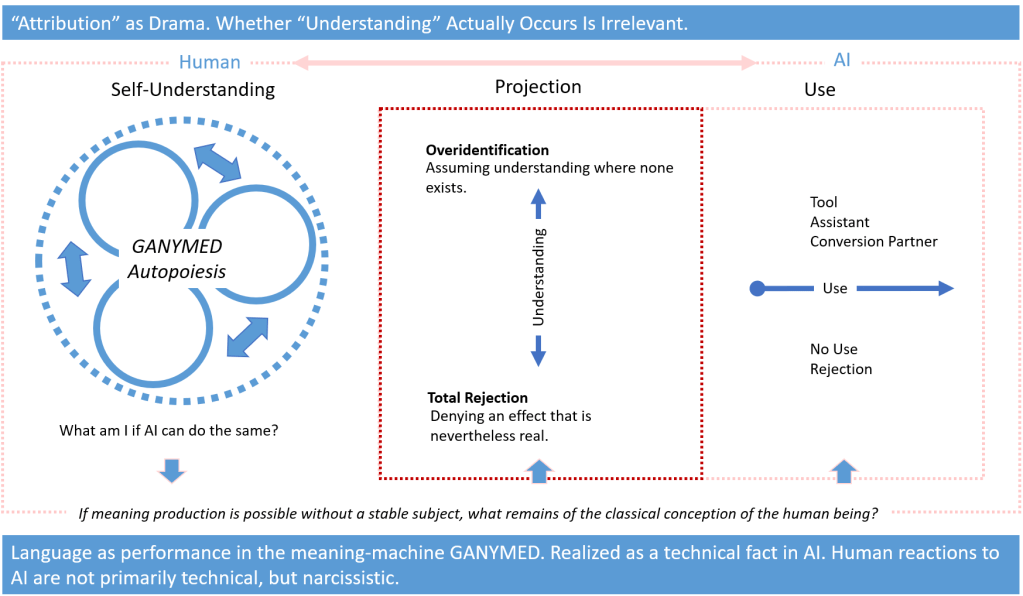
The three circles of autopoiesis in the diagram below illustrate that human self-understanding is not a stable point from which AI can simply be observed. It is itself a circular process, destabilized by the encounter with AI.
The question “What am I if AI can do the same?” is not rhetorical. It intervenes directly in the loop through which the self reproduces itself.
Two Questions Left Productively Open by the Diagram
The first concerns the axis of use (tool → conversation partner), which runs horizontally as though it were a neutral scale. But is the choice between these roles really free, or is it already shaped by the dynamics of projection? Those prone to over-identification will inevitably arrive at “conversation partner,” even if they insist on calling AI a “tool.”
The second concerns the red frame surrounding the projection zone, which marks projection as a danger area. Yet perhaps projection is not avoidable at all. Perhaps it is the condition under which human beings engage with language in the first place—whether the language belongs to another human being or to a machine. In that case, the task would not be to avoid projection but to remain conscious of it.
This is precisely where Ganymed, as a theatrical experience, has an advantage over the diagram. The audience experiences projection while watching. It cannot neutralize projection through conceptual framing. The projection occurs in real time, as part of the act of observation itself.
The Core Thesis
“Language as performance in the meaning-machine GANYMED. Implemented as a technical fact in AI.”
This may be one of the most important statements in the entire theoretical framework.
For it contains the central thesis:
AI does not invent this structure.
It reveals that language has always been operative.
Language does not merely represent a pre-existing meaning. It produces meaning in the act of its own execution. Meaning emerges, stabilizes itself temporarily, and dissolves again within the process of communication. What appears today as a novel property of artificial intelligence may therefore be less a technological innovation than a revelation of something that has always been present within language itself.
This is precisely where Ganymed becomes unexpectedly contemporary.
AI destabilizes our self-image more than it transforms our tools.
The central issue is not whether machines can write, speak, answer questions, or generate texts. The deeper issue concerns the assumptions that have traditionally underpinned our understanding of what it means to be human.
The fundamental crisis can be formulated as follows:
If the production of meaning is possible without a stable subject, what remains of the classical conception of the human being?
This is where Ganymed reaches directly into the center of the present moment.
Long before contemporary AI systems existed, the play was already operating with structures that have now become visible as technical realities:
- meaning without a stable center,
- perspectives without an owner,
- communication without guaranteed interiority,
- identity as performance rather than substance.
The figures do not possess meaning; they generate it. They do not express stable inner states; they participate in ongoing processes of relation, observation, and self-observation. Meaning emerges from the interaction itself.
Seen from this perspective, the diagram suggests something that is easy to overlook:
AI is not the rupture.
Rather, AI exposes a structure that Ganymed had already anticipated on a formal level.
The play demonstrates that language can function as a self-generating system of meaning. Contemporary AI demonstrates that such processes can also be implemented technologically.
What appears to be a technological revolution therefore turns out, at least in part, to be an epistemological revelation.
The human reaction to AI is consequently not primarily technical. It is narcissistic.
For centuries, language, understanding, intentionality, and meaning were regarded as uniquely human capacities. AI does not necessarily prove that these assumptions were false. But it does force us to confront the possibility that at least some of these capacities may depend less on a stable inner subject than we previously believed.
This is why debates about AI are often conducted with such intensity. Beneath questions of efficiency, safety, employment, or regulation lies a more fundamental uncertainty:
What becomes of the human self-understanding if the production of meaning no longer guarantees the existence of a uniquely human center?
Ganymed does not answer this question.
It stages it.
And perhaps that is precisely why the play appears more relevant today than when it was written. It does not describe the epistemological condition that AI has made visible.
It inhabits it.

