An Epistemic Play in Three Parts
Christopherus Steindor
Written 1974–1976
Slightly corrected stage version, 2026
English version, 2026
Editor’s Note
Ganymed was written between 1974 and 1976 and is published here in a slightly corrected English stage version. The text has retained its fragmentary structure, linguistic discontinuities, repetitions, and abrupt shifts of register. These have not been normalized in translation.
The artworks accompanying this edition are works by the author. They are not illustrations of individual scenes, but visual counterparts to the play.
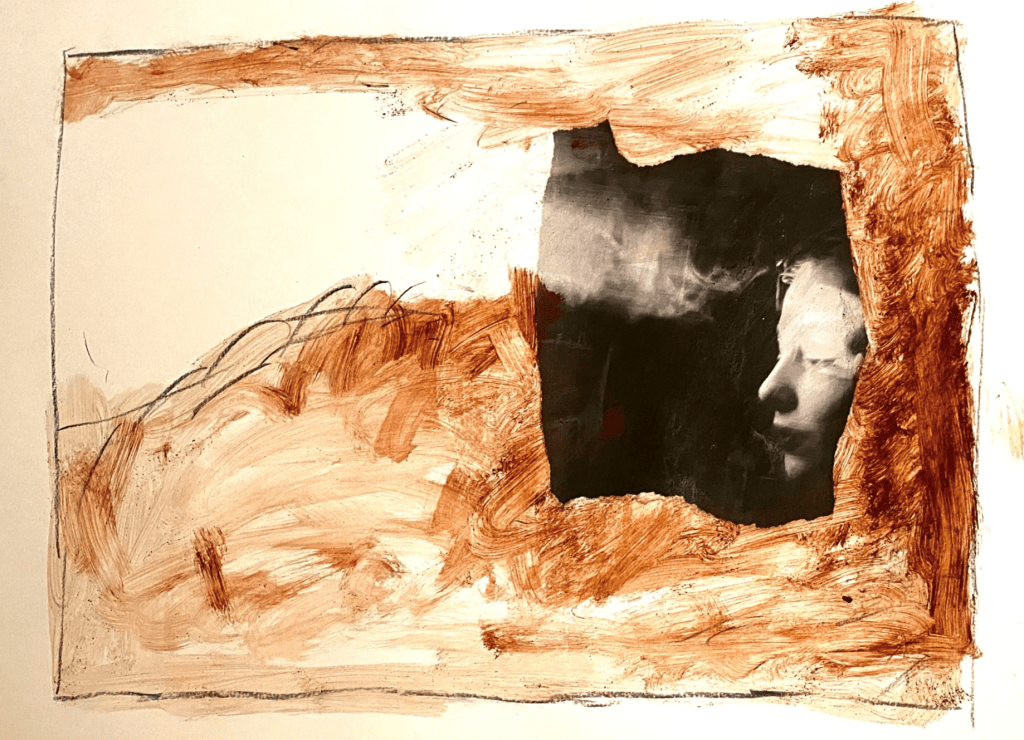
Artwork by Christopherus Steindor
PART ONE
People
- ZETT STERN, a conjugated complex number
- GANYMEDE, who rules as the cupbearer of the gods
- PSYCHE, the lover of Cupid
(Indeterminate space. Conversation between Ganymed and Zett Stern.)
GANYMED
I’ve got such-a-fucking
evangelical taste on my tongue.
ZETT STERN
Please …
GANYMED
That’s none of your fucking shit.
ZETT STERN
But I beg you!
GANYMED
At first, one thinks that triviality is
a byproduct of productivity,
but then it turns out that we are,
nolens volens, rooted in metaphysics.
ZETT STERN
I am a conjugate complex number …
GANYMED
Let me explain it to you differently;
imagine you were a pair of glasses.
Glasses for seeing.
You—the glasses—fall to the ground.
That is, you slowly slip
from your two ears and your nose,
feeling both the resistance of the air
and the pull of gravity.
When you hit the ground, your lenses shatter.
What do you suppose you would feel?
What would your ego look like afterward?
And what about your self-awareness?
(Pause)
Consider what dimensions
might possibly arise
from such a perspective!
(Pause. Ganymed looks at Zett Stern.)
Oh!
I believe I have detected
a trace of astonishment
on your face.
ZETT STERN
You’ve got to be fucking with me.
GANYMED
Fucking with you, fucking with you!!!
ZETT STERN
Forgive me, but I am only
a complex—no, a conjugate complex—
number.
I do not, in the slightest, feel
discriminated against because of this,
but my consciousness,
my consciousness … !
GANYMED
Oh papperlapapp.
You must not confuse one-dimensionality
with multidimensionality,
nor multidimensionality
with one-dimensionality.
Otherwise, you’re making a mistake.
A serious mistake.
A fundamental error of thought!
The dimensionality of the inner—
the introverted, the inward-turned—
and of the outer, the extroverted,
the outward-directed—
those dimensions, precisely those,
you’ve completely ignored.
You’re a eunuch, a gentleman without a tie,
a tree without branches!!!
ZETT STERN
… only a conjugate complex number …
GANYMED
I understand you.
I believe that I understand you.
Yes, I understand you.
ZETT STERN
Consider my existence.
And then that daisy,
growing there in the meadow.
Dream while you do it—
and close your eyes.
Immerse yourself
in this world …
in this world …
GANYMED
There is a connection,
a coherence—
the glasses … and the daisy.
The introversion and the extroversion.
Yes, the problem of Zwischenzeitlichkeit.
I have been thinking about it
for a long time.
It is the problem
of Zwischenzeitlichkeit.
ZETT STERN
But I do not understand you.
GANYMED
Shut up, damn it!!
Don’t you dare interrupt
my train of thought again!!
You— you bastard.
ZETT STERN
But …
GANYMED
Please!!!
Where was I— was I …
ZETT STERN
Please?
GANYMED
The thought.
ZETT STERN
Thought?
GANYMED
The thought of You …
ZETT STERN
Of me?
GANYMED
No — of “You.”
ZETT STERN
So it is me after all.
GANYMED
No, damn it, “You.”
ZETT STERN
Ah— I see, “You.”
GANYMED
The thought of you.
ZETT STERN
What does she look like?
GANYMED
The Zwischenzeitlichkeit?
ZETT STERN
No, not what „she“ looks like!!!
GANYMED
I don’t understand you.
ZETT STERN
I mean, I mean … what do I mean
Actually?
…I’ve forgotten what I wanted to say.
GANYMED
Please!!
ZETT STERN
I am only a conjugate complex number.
(Zett Stern throws himself to the ground.)
Kick me!
Beat me!
I deserve it.
GANYMED
Get up—please,
if anyone sees us!
(Zett Stern gets up.)
GANYMED
Don’t you ever do that again
in my presence!
It’s disgusting!
You’re behaving like a pig!
ZETT STERN
I imagined myself to be a pair of glasses,
slowly slipping
from both ears and nose,
feeling the resistance of the air
and the pull of gravity,
and how I shattered.
… I know this feeling.
Yes, I know this feeling.
GANYMED
Describe it!
ZETT STERN
I can not.
GANYMED
Describe it!
ZETT STERN
I can’t do!
GANYMED
Describe it!!
Describe it!!
(Ganymede steps after Zett Stern)
Describe it!!!!
(Zett Stern drops to the ground. He holds his hands protectively over his head. No whining or whining.)
Describe it!!
Describe it!!
Describe it!!!
(Ganymede roars)
Damn it,
you’re supposed to fuckin’ describe it!!
ZETT STERN
I — can — not!!
GANYMED
(Ganymed is calm and composed again.)
Bastard … You… Pig.
ZETT STERN
May I get up again?
GANYMED
No.
(Ganymed thinking)
Yes.
Get up.
You disgust me.
But— I forgive you.
Get up.
(Zett Stern gets up.)
ZETT STERN
Forgive me, please,
that you had to hit me.
(Ganymed waves it off.)
If I only knew how to explain it.
If I had the words to speak,
and if there were ears that could understand me,
that could hear me.
I want to be free.
Free like a bird.
No— like a cloud …
GANYMED
… blown by the wind.
No—
I want to be the wind.
Gravity.
Magnetism.
I want out of our temporality,
out of this temporality.
I want into the dimension of the introverted.
I want to be the inner-outer.
The outward-turned inner.
I WANT TO WILL!!!
ZETT STERN
We are all figures,
numbers,
and I am a conjugate complex number.
What does it matter?
GANYMED
You are insane.
ZETT STERN
You are oppressing me.
Yes, you are oppressing me.
You have oppressed me from the very beginning.
You only want to exploit your power.
GANYMED
You accuse me?
ZETT STERN
I condemn you!
GANYMED
Do I deserve this?
I ask you, do I deserve this?
You want to make me a figure,
a mere number, and condemn me.
What did I do to deserve this?
ZETT STERN
I am tired of being oppressed.
I am a conjugate complex number,
and I am proud to be so.
I am proud to be
what I am,
and I want to remain so.
I want to be a figure,
a number.
I want to be a blade of grass,
a blade of grass among many,
a blade of grass like so many …
I want to be nothing …
… for I am nothing.
All my life I have achieved nothing,
and I will never achieve anything.
And I am proud of that.
Perhaps I am insane …
(softer)
Or perhaps I am simply normal.
GANYMED
I judged you correctly
from the very beginning.
But I will tell you
a small episode nonetheless.
I was once a small Wachtelhund,
and an orphan as well.
A cyclist struck me unconscious
with his walking stick
because I had barked at him.
ZETT STERN
I’m sorry about that.
GANYMED
You don’t have to be sorry.
I don’t need your pity.
I don’t need anyone’s pity.
Because I am strong.
ZETT STERN
You are neither inside nor outside.
You are somewhere in between.
And if you’re not careful,
there will soon be nothing left of you …
and …
and you will become like me.
You will be
a conjugate complex number.
Like me—nothing.
Please don’t do this to yourself.
Don’t do it to me.
Don’t do it to humanity.
(Pause)
I am disappointed.
Most of all in myself and in you.
Perhaps more in you
than in myself.
Or perhaps more in myself.
Yes, I have disappointed myself.
I had hoped to be insane,
and now I must realize
that I am completely normal.
GANYMED
I did not hit you
to show you how normal I am.
No— I wanted to humiliate you.
I wanted to hear you scream.
I wanted to expand my field of perception.
I wanted to expand
my field of experience.
One must degrade oneself
in order to be low.
You must not misunderstand me.
Not for the sake of purpose,
but for the sake of Zwischenzeitlichkeit
I think of “You.”
I do not mean you,
the conjugate complex number,
but “You,”
and I will not
reveal my secret.
Do you understand?
You must understand me,
otherwise everything was in vain.
ZETT STERN
Yes, yes—
I understand you.
I most certainly understand you.
At least, I think
I understand you.
GANYMED
So my problem lies in the Zwischenzeitlichkeit.
No matter how much I tell you about it,
I do not understand it myself.
Perhaps you can help me
when I can no longer help myself—
if I can be helped at all in the end.
ZETT STERN
You cannot be helped.
GANYMED
(absently)
I cannot be helped?
ZETT STERN
I cannot be helped either.
And why— I ask you,
why should things turn out any better for you
than for me?
GANYMED
You can’t just …
ZETT STERN
Whether I can or cannot
is not the point here.
Perhaps the question is
whether you can still be helped.
And I say:
None of us can be helped anymore.
We are all hopelessly stupid.
Do you understand me?
GANYMED
But I don’t want to be stupid.
ZETT STERN
You’re behaving
like a little child.
GANYMED
Who gives you the right
to say that?
ZETT STERN
Whether anyone gives me the right
or not
is completely irrelevant.
In the end, only the thought counts.
The only thing that is ideal
is the ideal itself!!!
GANYMED
I haven’t even thought about that.
ZETT STERN
No wonder— you’re stupid in a completely different way than I am.
GANYMED
But you’re either stupid or you’re not!
ZETT STERN
Not at all— you’re mistaken.
You are stupid in a different way than I am,
and I am stupid in a different way than you are.
If I were just as stupid as you—
that is, stupid in exactly the same way as you—
then I would be you, and you would be me,
that is, we would be identical.
But since we are not one person,
but two, or three,
we are not identical—
we are differently stupid.
GANYMED
And how does that relate to the Zwischenzeitlichkeit?
ZETT STERN
Please, leave me alone with your problems—
I have enough to deal with my own.
You know, I am a conjugate complex number.
GANYMED
I must say, I underestimated you.
I damn well underestimated you.
And I overestimated myself.
I damn well overestimated myself.
But then, I’ve never really known how to estimate anything.
I have always concerned myself only
with myself and my Zwischenzeitlichkeit,
a Zwischenzeitlichkeit
that is perhaps more unclear to me
than it is clear to you.
In the end, everything is just as it was at the beginning.
And I feel like the glasses again,
or like that little Wachtelhund
– this poor guy
whose eyes were bulging.
If only I could understand myself.
Perhaps I would understand “You”.
Perhaps then I would understand myself as well.
ZETT STERN
No, it’s hopeless.
Every attempt would fail.
I want to tell you the story
of the man who worshipped that chainsaw—
at least, it looked
as though he were worshipping it.
He was kneeling on the ground,
holding it with both hands,
and sawing through a tree trunk
just lying there.
GANYMED
So these are the limits.
These are the limits we cannot cross—
between us,
—and ourselves,
because
we do not know ourselves.
ZETT STERN
I think we do not even want to know ourselves,
because we do not know that we do not understand ourselves,
that we ourselves,
do not even understand ourselves.
GANYMED
What we are left with – are the memories.
ZETT STERN
Memories of masses of snow
flying straight into our faces,
or of oranges
that taste sweet.
GANYMED
Or memories of better times,
of thoughts— thoughts one has.
These are then the thoughts
that become memories,
memories
that are in fact thoughts.
For when the moment comes,
we stop thinking,
and only remember,
and time becomes Zwischenzeitlichkeit again
or something else,
and we completely stop understanding ourselves,
we completely stop trying to understand ourselves.
ZETT STERN
What we need is—
well, what we need is Halt …
at least I think it is Halt,
or something like it.
Perhaps understanding,
affection,
which we deny each other,
or something else.
GANYMED
Then our old life comes to an end,
and it ceases to be simply life,
we stop living the day—
we begin to live the day.
ZETT STERN
Do you know this feeling,
when you live your thoughts,
live them as if they were reality?
As if they were more ideal than the ideal?
These are then these—my thoughts.
And no one can take them away from me.
No one can take them away from me!!!
No one can take them away from me!!!
GANYMED
And I know that I understand you!
ZETT STERN
I am not only myself,
but also a part of myself,
and not only a part of myself,
but at the same time the whole.
All at once I am more than mere mass,
all at once I am myself part,
I am myself part,
I am myself part and yet whole!
GANYMED
And then—
we ourselves are part,
are ourselves part,
and yet whole.
– Curtain –
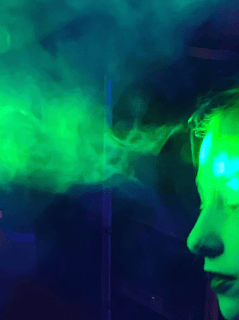
Artwork by Christopherus Steindor
PART TWO
Characters:
ZETT STERN
GANYMED
PSYCHE, beloved of Amor
In a park. It is afternoon, almost evening.
Birdsong.
A bench, two chairs, a table.
On the table: food and drink.
Psyche lies on the bench.
Ganymed stands beside the table, serving her.
GANYMED
We must drink, dearest Psyche,
the wine shall make us drunk.
PSYCHE
Pour forth,
O my Ganymed,
for to receive the draught from thee
is sweeter far
than drinking of the finest wine.
GANYMED
(smiling, pours, sits beside her)
Let us raise our cups
and drain them at a breath,
that we may make room
to fill it yet again with this same draught,
this wondrous liquor
that floweth from the vessel.
PSYCHE
Ay, let us drink
and quench our thirst.
GANYMED
It is not thirst—
I would destroy my brain,
drown all my thoughts,
drown all those thoughts
that bind me fast.
Let me slay the ancient grief
I bear within—
let me weep.
PSYCHE
Let thy tears flow,
let thy sorrow be,
and let us hearken
to the murmuring sounds
in trees and hedges
that the evening softly sings.
(They listen to the birdsong. Zett Stern enters; he espies Ganymed and goes toward him to greet him.)
ZETT STERN
Ganymed! Damn it, that I should meet thee here!
GANYMED
I think we have not seen each other
for a long while.
ZETT STERN
(turning now also to Psyche)
… and Psyche as well.
PSYCHE
Drink with us, brother dear!
We would drown our thoughts,
destroy the brain!
ZETT STERN
Our mind is the only good
that we truly possess.
We cannot kill our thoughts—
we may numb them
for a while,
but we cannot kill them.
We would have to kill ourselves,
and not even then are we certain
whether our thoughts
might yet persist,
and whether we have only destroyed
our mortal shell.
GANYMED
Then let us drink ourselves to ruin,
that we may numb our senses,
that we may not behold
what we truly are.
PSYCHE
What we think and what we are—
must we not look into the mirror
ere we bring our souls to market?
I ask you:
what are we,
and where is our worth measured?
I ask you:
for what are we here,
and why do we exist?
I ask you—what are we?
…and where is our worth measured?
I ask you, what will you do
when you come to see
that you have given away your soul?
GANYMED
Thou art right.
We must cast off our past
once and for all.
I must forget
what I was.
ZETT STERN
We must forget
that we ever were.
PSYCHE
We must not play at fate.
We must not will
to govern fate.
ZETT STERN
I think
we must not guide
what we must not guide,
what we cannot guide.
GANYMED
Pour, my friends—
let us be drunk with wine.
– Curtain –
PART THREE
(A bench, a chair)
ZETT STERN:
I’ve got such a fucking
evangelical taste on my tongue.
PSYCHE:
Please?
GANYMED:
We are conjugate complex numbers.
ZETT STERN:
Oh, I believe I have detected
a hint of astonishment
on your faces.
How we must feel,
what we think of ourselves,
and who we are.
We must not confuse
who we are
with what we are.
We must not sit in judgment
over those
we do not know.
Triviality is merely a byproduct
of productivity.
What we are rooted in,
we do not know.
We are gradually beginning
to observe our existence,
and in doing so
we neglect
the decisive dimensions.
We speak of daisies
and mean the glasses on our nose.
We speak of connections
we do not understand.
We speak of trains of thought
that are derailments of thought,
or simply statements about ourselves—
what we are and what we represent,
and how we act,
how we ought to act..
GANYMED:
We imagine ourselves to be a pair of glasses,
slowly slipping
from our ears and our nose,
feeling the resistance of the air
and the pull of gravity—
and how we shatter.
(Ganymed lies down on the bench.)
I know this feeling,
when I dissolve into my components
and no longer know
who or what I am.
I know this feeling,
of infinite heaviness,
when I feel my bones turn to stone,
when I think
I am a block of concrete.
I leap down
from rocks
and drive in cars
that no longer want to stop,
I drive in cars
that take on a will of their own,
that take possession of me,
and someone has fixed the gas pedal,
and I drive faster and faster
and the road stretches on without end
and I merge with it,
and merge with the road I am driving.
PSYCHE:
I want to be free, free from myself.
I want to fly with myself.
Fly away, from myself.
Remain with myself.
I want to give myself to my thoughts..
GANYMED:
(rises, to Psyche)
Your thoughts?
PSYCHE:
My thoughts are my dreams,
and my dreams drift away
like clouds.
They weave through my mind,
weave through my body,
make my hands tremble.
Let me speak—
so I will be silent.
My words are not words.
My words are dreams,
are thoughts
in my subconscious.
I am the product of these dreams.
I have thought myself,
and yet I am myself,
and yet entirely myself.
What I will do—
damn it,
I do not know.
Action is not my domain.
Thoughts direct me,
direct you—
thus we are three prisoners.
Our prison is our mind.
We presume
to be able to solve
the problems of humanity,
and do not even understand ourselves.
What we should do—who knows?
What will happen—who knows?
What we should know—who knows?
And one day, the day will come
that we fear.
We freeze before the mighty voice
that calls us to turn back.
But we have forgotten our origin,
have forgotten who we are
and what we are.
We want out of Zeitlichkeiten
we do not understand.
Episodes from our lives,
rambling, without connection.
Desperately you try to find meaning
in what you do and say.
And what you do, you say,
and what you think, you speak.
But I want to be free—
free of why,
I want to live.
GANYMED:
We don’t need your pity.
Our days. Our nights.
Our thoughts.
No, I don’t need your pity.
I am a number, a number like you
(points to Psyche)
and you
(points to Zett Stern).
ZETT STERN:
What nonsense!
I am who I am, and I know what I am.
I don’t give a shit about my field of perception.
I won’t let myself be turned into your fuckin’ popanz!
Go on—laugh at yourselves!
Decide who is stupid
and who is not!
Go on like this!
I know what I am
and I want what I want!!
PSYCHE:
Let us go.
GANYMED:
No, Psyche, there is still too much unsaid
that must be spoken,
too much that does not make sense.
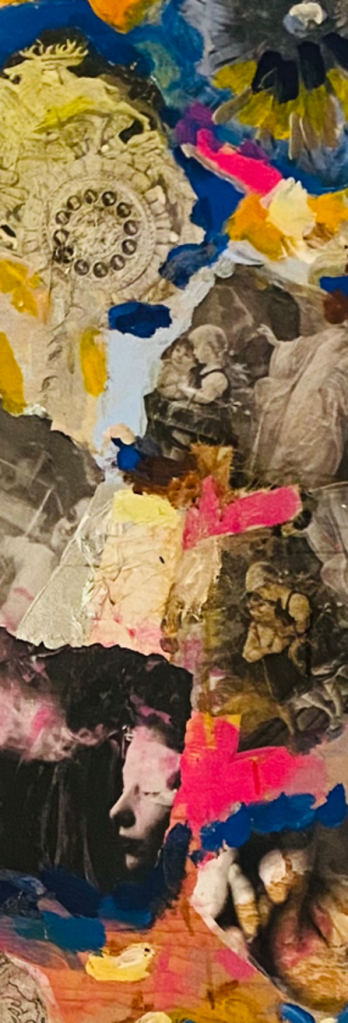
Artwork by Christopherus Steindor
PSYCHE:
Not for rhyming we came together, not to straighten.
Our paths have brought us together.
They will lead us apart again.
I stood in the room.
Before me, nothing.
Behind me, only the shadow
cast by a lamp.
In the mirror, we stand before ourselves.
I ask you:
Do we not float
between the chaos of dream and reality?
ZETT STERN:
(to Ganymed, he points to the bench, sits down on the chair beside it during the conversation)
Please lie down here on this bench,
relax,
and begin to speak.
GANYMED:
She had jet-black hair,
and from her green eyes
her temperament sparkled.
Her walk was smooth, like that of a cat.
Yes, she resembled a cat,
and I firmly believe
that she was a cat,
or is.
ZETT STERN:
Enough words.
Back to the parable.
Many years ago, I was a rich man.
I owned thousands of fields.
The draw well in the middle of the courtyard of my house
always yielded fresh water.
But one day, cornflowers and thorny plants
hindered the young growth of my fields,
and a prophet came along the road
and asked me—
GANYMED:
No— please, shut the hell up!
ZETT STERN:
(offended)
I am silent.
I am silent,
because it is better now
if I remain silent.
PSYCHE
The analysis of being
is the fragment
of thoughts not carried through to the end.
GANYMED
All at once we are more than mere mass,
all at once we ourselves are part,
and yet whole!
ALLE
(turning to the audience)
And all at once we ourselves are part – and yet whole!
— Curtain —
FIN
Notes on Terms and References
Conjugate complex number
A mathematical term. If a complex number is written as z = a + bi, its complex conjugate is z̄ = a − bi: the real part remains unchanged, while the sign of the imaginary part is reversed. The expression recurs throughout Ganymed and is deliberately transferred from its mathematical context into the dialogue.
Zwischenzeitlichkeit
A German neologism combining zwischen (“between”) and Zeitlichkeit (“temporality”). It may approximately be rendered as “in-between temporality” or “being between times.” The play leaves the term deliberately undefined.
Temporality / Zeitlichkeiten
Zeitlichkeit is the German term for “temporality,” the condition of existence or experience as structured by time. The plural Zeitlichkeiten literally means “temporalities.” Where the German word is retained in the English text, its foreignness is intentional.
Papperlapapp
An old-fashioned German exclamation used to dismiss something as nonsense or irrelevant, roughly comparable to “pish-posh,” “nonsense,” or “rubbish.” Its slightly comic and antiquated tone is part of the expression.
Wachtelhund
Literally “quail dog.” The Deutscher Wachtelhund (German Spaniel) is a German hunting-dog breed traditionally used for flushing and retrieving game. In the play, the word is meant literally, despite the unexpected context in which it occurs.
Halt
The German noun Halt means support, stability, or something that gives a person inner or external security—something to hold on to. It should not be confused with the English word “halt,” meaning “stop.”
Popanz
A German word originally referring to a frightening dummy, bogeyman, or scarecrow. Figuratively, it can describe an artificially inflated figure of authority or menace, something made important or intimidating by those who construct or invoke it.
Nolens volens
Latin, literally “unwilling, willing”: whether one wants to or not; inevitably or willy-nilly.
Ganymed and Psyche
Ganymede (Ganymed in German) is a figure from Greek mythology, a beautiful Trojan youth carried away by Zeus and made cupbearer to the gods.
Psyche is the beloved of Eros (Amor/Cupid); her name, Greek psychē, also means “soul” or “breath of life.” The character’s name in Ganymed was directly inspired by Heinrich Heine’s poem Amor und Psyche. Heine’s poem thus forms part of the literary background of the play, alongside the underlying mythological tradition.
About the Work
Ganymed was written by Christopherus Steindor in 1974–1976. This English version is based on the slightly corrected 2026 stage version. The accompanying artworks are by the author.
 #Pokemonfury