When a prompt becomes code and a literary text is transformed into a new medial operation
For another experiment with my 1974 play Ganymed, I used ElevenLabs to transform the beginning of Part One into a song. The starting point was not a fully developed musical arrangement, but a comparatively short prompt:
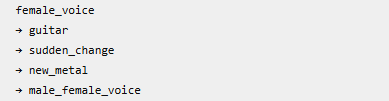
female voice singing with guitar then sudden change to new metal with male voice and female voice
At first glance, this seems like a simple production instruction. Functionally, however, it can be read as a representation of code. It does not describe the content of the song. Instead, it specifies the conditions under which the text is to be transformed.
Very schematically:
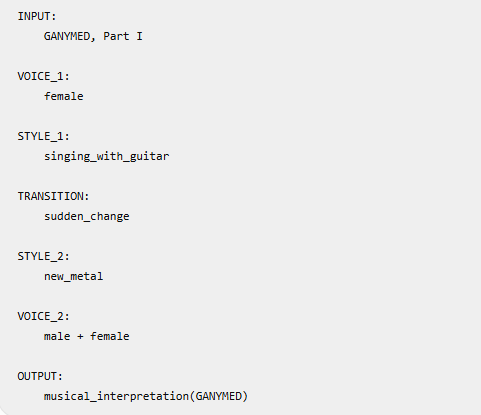
The prompt already contains a small dramaturgy. It defines an initial state, a rupture, and a second state.

he code does not write the text. Nor does it fully determine how the text is to be understood. Rather, it provides a transformational regime within which a generative AI reorganizes the literary text musically.
That is precisely what makes the experiment interesting.
The Text as Code
Ganymed itself can also be viewed in this way.
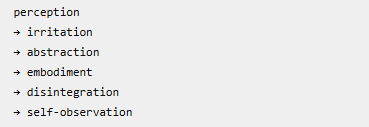
The opening of the play does not merely consist of statements. It initiates a sequence of operations. Ganymed begins with an irritating bodily perception — an “evangelical taste” on his tongue — moves from triviality to metaphysics, and then asks Zett Stern to imagine himself as a pair of glasses. The glasses fall to the ground, shatter, and give rise to questions about feeling, ego, and self-awareness.
If this sequence is translated not semantically but operationally, it might look something like this:
observe(body_sensation)if sensation == strange: articulate()shift( triviality, metaphysics)address(other)if other == "conjugate_complex_number": destabilize_identity()imagine(self_as_glasses)while falling: perceive(air_resistance) perceive(gravity)on_impact: shatter()ask: what_happens_to(feeling) what_happens_to(ego) what_happens_to(self_awareness)
This is, of course, not executable programming code. But it makes one quality of the text visible: Ganymed generates meaning not only through statements, but through sequences of operations.
Perceiving.
Asserting.
Irritating.
Shifting.
Imagining.
Shattering.
Questioning.
And observing again.
The text therefore already contains something like a poetic flowchart.
When Prompt and Text Meet
Now two “codes” encounter one another.
The literary code might schematically read:
The prompt-code, by contrast:
The AI has to mediate between these two structures.
The result is therefore not simply a setting of the text to music. The system has to make decisions: Which passages remain quiet? Where does a rupture seem appropriate? Which voice carries which tension? When does intimacy turn into aggression?
A third order emerges from two different ones:
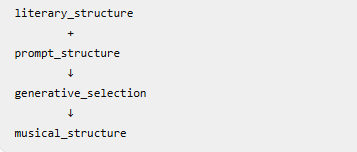
This is what I call algorithmically mediated poetic transformation.
The AI Does Not Translate Words, but Relations
The comparison with my earlier visual experiments with Ganymed is particularly revealing.
In image generation, the AI repeatedly seized on easily visualizable objects: glasses, wine, mathematical signs, figures. It translated the text mainly through its iconic anchors.
Music operates differently.
It does not have to show a pair of glasses.
Instead, it can make the act of shattering audible.
It does not have to depict a complex number.
It can move between different voices, registers, and sonic spaces.
It does not have to represent irritation.
It can produce it.
Machine interpretation therefore shifts from objects to relations and transitions.
IMAGE_AI: object → representationMUSIC_AI: tension → transformation contrast → dynamics rupture → genre_change
The abrupt transition I specified — from female voice and guitar to new metal with male and female voices — provides a structure for this. The machine is not told what philosophical meaning the change is supposed to carry. It must relate the formal shift to the existing text on its own.
The prompt therefore determines the form of difference, not its complete meaning.
Is This Code Poetry?
In the traditional sense, only partially.
In classic Code Poetry, programming code itself becomes poetic material. Here, the actual software code remains invisible.
But functionally, something related is happening.
My prompt can be read as code. The literary text can be read as an operational structure. A generative system connects the two and produces a new poetic state.
For that reason, I would describe it as AI-mediated Code Poetry — or, more precisely, as algorithmically mediated poetic transformation.
The code is no longer necessarily the visible poem.
It is the condition of its transformation.
The Work as a Series
This also changes the question of where the work itself is located.
First there is Ganymed as text.
Then Ganymed as machine-spoken performance.
Then the AI-generated visual interpretation.
Then the screenplay.
Then the film.
And now the musical versions.
GANYMED_1974 ↓AI_voice ↓AI_screenplay ↓AI_visualization ↓film ↓music_prompt ↓song_version_1 ↓song_version_2 ↓...
None of these versions replaces the source text.
Each one is a new observation of the same material.
The poetic work increasingly consists of the series of its algorithmic translations.
And perhaps this is where the actual Code Poetry of the experiment lies.
Not in the source code.
Not in the prompt alone.
Not in the generated song.
But in the difference between the states.
The Prompt as an Instruction for Observation
The prompt therefore acquires a second function.
It is not only a production instruction, but an instruction for observation.
With
female voice→ guitar→ sudden change→ new metal→ male + female voice
I am implicitly asking the machine:
What happens to this text if you observe it under these conditions?
The answer does not take the form of an explanation.
It takes the form of music.
And precisely for that reason, something becomes observable that the original text alone cannot reveal: how a generative system translates its tensions, ruptures, and transitions into another medium.
Perhaps this is the decisive extension of the concept of Code Poetry:
The code no longer has to be the poem itself. It can create a space of possibilities in which poetic transformation becomes observable.
The prompt, then, is not merely a command addressed to a machine.
It becomes part of the work.
Version 1: Shattered Resistance
Version 2: The Shattered Glass
Version 3: The Gravity of Shattering (alternate prompting)

