What happens when a literary text is not only read, but translated by AI into images, voices, and scenes?
For an experiment, I had my 1974 play Ganymed spoken in full by AI-generated voices. The text was then transformed by AI into a screenplay and finally into a visual sequence. One thing soon became apparent that may seem trivial at first, but is theoretically quite revealing: the AI almost exclusively selected the most obvious images contained in the text.
Wine became wine glasses. The complex number became a mathematical representation. The glasses became glasses. Clouds became clouds.
At first, this seems perfectly plausible. Ganymed offers enough visually accessible material. At the beginning of Part Two, for example, the figures are placed in a park; food and drinks stand on a table. Ganymed urges Psyche to drink, so that the wine may intoxicate them.
It becomes more interesting, however, when the AI does not merely illustrate, but produces a new meaning through its act of selection.
Two visual versions were generated for the opening of Part Two. In the first, Ganymed was placed above Psyche. A red curved line led downward from him toward her. Formally, this was probably intended as a connection, a movement, or perhaps a reference to wine. Yet the image produced an entirely different association: it looked as if Ganymed were urinating down onto Psyche.
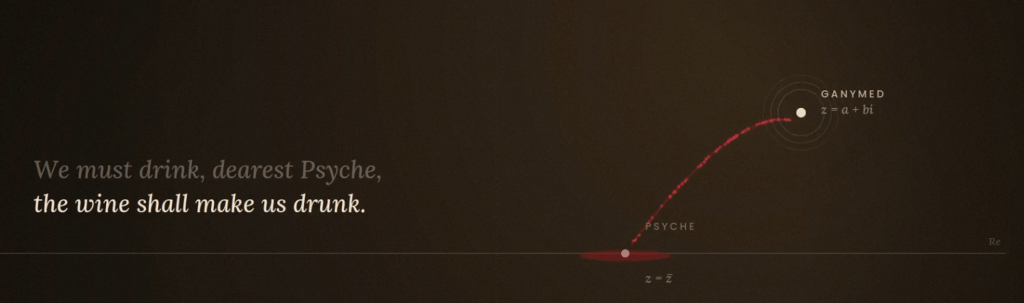
Versthe algorithmically mediated movement between different forms of meaning.ion 1 – the algorithmically mediated movement between different forms of meaning. GANYMED Part II
After I pointed this out, the AI generated a second version. The red line disappeared. In its place, two wine glasses appeared between the figures.
What matters here is not the comic misinterpretation itself. What is more interesting is the sequence of observations.
The literary text is observed by the AI.
The AI selects elements and generates an image.
That image is then observed by a human.
The human observation irritates the machine.
The machine responds by producing a new visual interpretation.
A recursive chain emerges:
Text → machine observation → selection → image → human observation → correction → new image
This is where, for me, the experiment begins to approach Code Poetry.
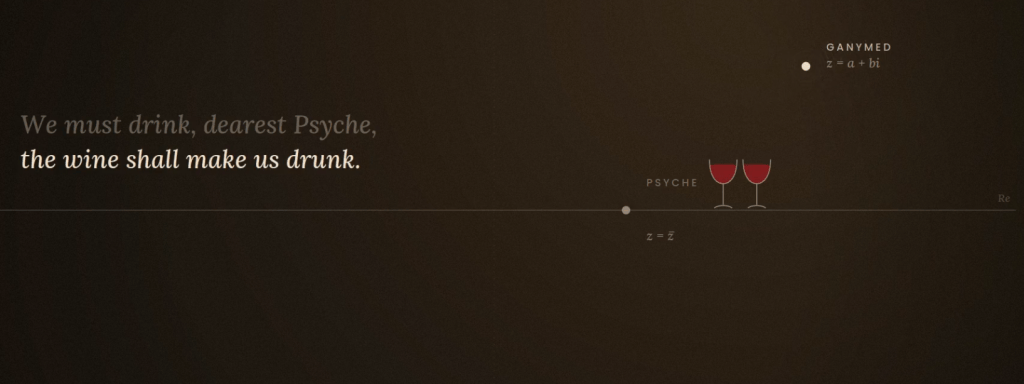
Version 2 – a form of generative Code Poetry. GANYMED Part II
In the narrow sense, Code Poetry refers to texts in which programming code itself becomes poetic material. In this experiment, however, the code is not visible. It operates in the background as a transformational apparatus. The poetic quality does not arise from the syntax of a program, but from the algorithmically mediated movement between different forms of meaning.
One might therefore speak of a form of generative Code Poetry.
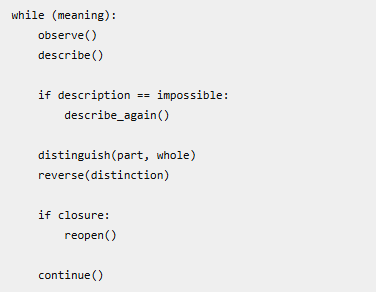
Easy Code: How does one visualize the impossibility of fully describing an experience?
What is crucial is that the AI seems to prefer visualizing what can easily be translated into objects, figures, or spatial relations. By contrast, the operations that are central to Ganymed resist immediate visualization.
How does one visualize Zwischenzeitlichkeit — an in-between temporality?
How does one visualize the impossibility of fully describing an experience?
In Part One, Ganymed repeatedly demands that Zett Stern describe the experience of shattering like a pair of falling glasses. Zett Stern finally answers: “I cannot.”
The glasses can easily be shown.
The failure of description is far more difficult to show.
The same applies to another central motif of the text: the relation between part and whole. At the end of Part One, the figures formulate the idea that they are simultaneously part and whole.
Again, what matters is not the image itself, but the paradoxical operation that resists definitive closure.
This is where the epistemic value of the AI experiment emerges.
The AI does not merely illustrate Ganymed.
Through the AI, Ganymed makes observable how the AI selects meaning.

Code Poetry applied on GANYMED
What becomes visible also reveals what remains invisible.
The wine appears.
Zwischenzeitlichkeit disappears.
The glasses appear.
The failure of self-description remains unseen.
The complex number can be placed on a mathematical plane.
The paradoxical experience of being simultaneously part and whole resists simple visualization.
The role of the literary text therefore changes. It is no longer merely the object of interpretation. It becomes an observational arrangement.
The decisive question is no longer:
What does Ganymed mean?
But rather:
What does Ganymed make visible when a generative AI attempts to understand it?
In this sense, Code Poetry would no longer simply mean poetry written with code.
It would be a poetry emerging in the intermediate space between text, algorithm, and observer.
The work would then no longer reside entirely in the original text, nor in the generated image, nor in the underlying code.
It would reside in the difference between the translations.
And perhaps this is precisely where a new form of epistemic literature begins: where a text does not merely show something, but makes visible how an observer — human or machine — comes to see something at all.
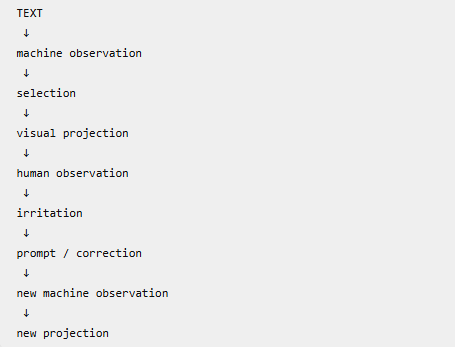
Very schematically: AI-mediated Code Poetry
The “code” is not visible here. Nor does it write the text itself. Instead, it functions as a transformational regime between different media. The poetic work therefore no longer consists solely of Ganymed, nor solely of the film produced from it. It consists of the series of its algorithmic translations.

