In 1972, my brother and I made a series of objects together. We called ourselves the KH + CH Group. We started with everyday objects and made them spill out: matches, coloured pencils, medicines, and also a pack of Peter Stuyvesant cigarettes. From the opened cigarette pack, a red, bodily-looking form emerges and spreads across the surface beneath it.
It looks like a bleeding pack, its plasma beginning to coagulate into a viscous mass. The pack itself provides further signs: brand name, typography, numbers, white, red. Yet these signs do not add up to an unambiguous story.
The object remains open.
More than fifty years later, I gave a photograph of this work to a generative AI. What emerged was a historical advertisement: Peter Stuyvesant suddenly appears as a figure from a bygone era, sailing ships enter the scene, and tradition, order, and quality are invoked. The red form becomes part of a dramatic advertising aesthetic.
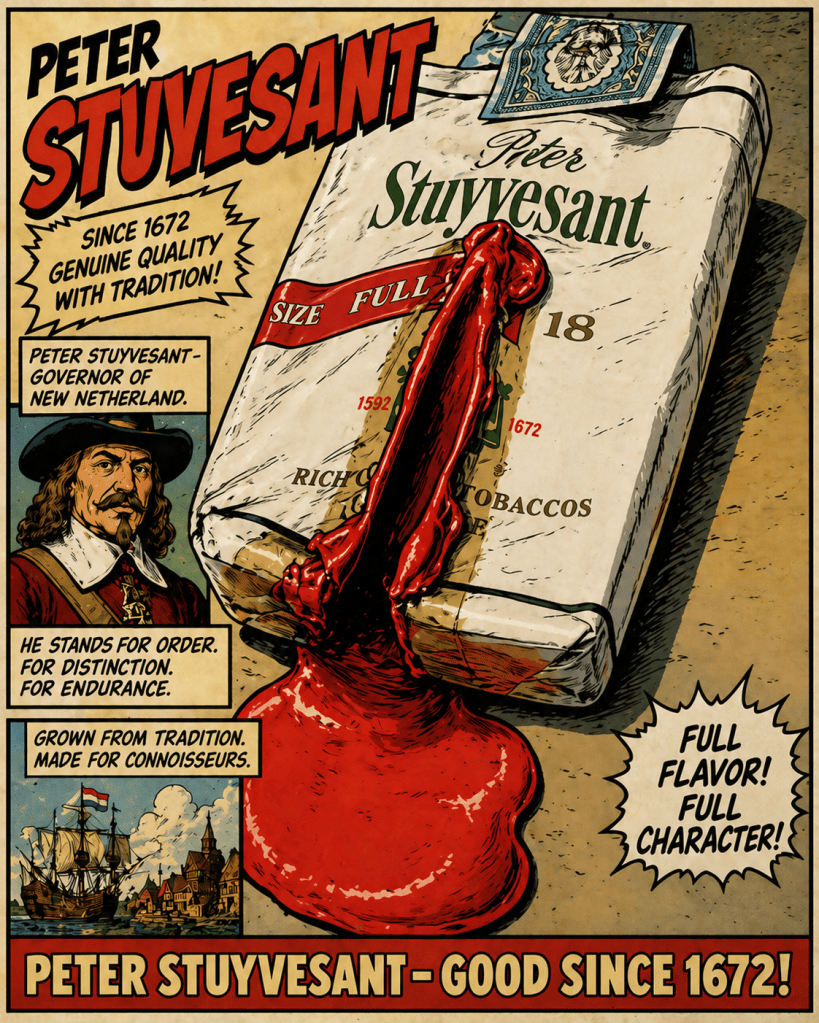
AI-generated transformation of the artwork “Untitled” — KH + CH Group (1972). Starting from the original image, the AI generates a fictitious historical advertisement and transforms the open visual constellation into a plausible narrative of tradition, authority, and quality.
The AI had not simply altered the original image.
It had continued its story.
And it told a story that had never existed.
Why Does Something False Look So Right?
It would be easy to dismiss the result as a typical hallucination of generative AI.
Historical connections are invented, dates are linked, visual motifs are added, and from them a past is constructed that never existed in this form.
But that might mean overlooking precisely what is most interesting.
Because the result does not appear random at all.
It possesses a peculiar plausibility.
The typography looks like historical advertising. The colour scheme fits. Sailing ship, merchant or governor, tradition, tobacco, and promises of quality reinforce one another. Even the invented advertising slogans seem so familiar that one could almost mistake them for authentic historical copy.
The question, therefore, is not only:
Why does AI produce something false?
The more interesting question is:
Why does this falsehood appear so plausible to us?
Plausibility and truth are evidently not the same thing.
An image can be historically false and yet highly compatible with familiar cultural patterns.
Style Is More Than a Surface
This became even clearer in further experiments.
I had images transformed into different aesthetic forms: Romanticism, Expressionism, Japanese ink drawing, photorealism, comics, and other stylistic worlds.
At first, one might assume that the object remains the same and that only its external appearance changes.
But that is precisely what does not happen.
Each style also changes what becomes important in the image.
A Romantic landscape requires different relations between foreground, horizon, light, and nature than an Expressionist representation does. A Japanese ink drawing reduces differently from a comic. Photorealism, in turn, creates different expectations of what should appear relevant or credible.
Style, then, is not merely decoration.
It functions as an order of selection.
AI does not simply translate an already fixed object into different aesthetic languages. Each time, it reconstructs the object under different conditions of visibility.
Some elements are amplified, others weakened, some disappear altogether, and occasionally something emerges that was not present in the source image at all.
The image remains the same — and at the same time becomes another.
When Images Begin to Drift
This process became particularly visible in serial transformations.
When a new AI-generated version was no longer based on the original image but on the immediately preceding transformation, the composition gradually moved further away from its starting point.
At first, the changes were barely noticeable.
A mountain shifted slightly farther into the background. A form became more strongly emphasised. The relationship between foreground and background changed.
But every small change became the new starting condition for the next generation.
What had previously been a deviation became a premise.
And on the basis of that premise, the next deviation could occur.
After several steps, an image had emerged that still bore a recognisable genealogical relationship to the original, yet no longer corresponded to it.
The AI had not simply accumulated errors.
It had recursively stabilised its own previous selections.
Here lies an interesting parallel with social processes. Decisions, descriptions, or interpretations can likewise become premises for later decisions. What was initially contingent may eventually appear self-evident because subsequent operations are already building upon it.
From a Space of Possibility to a Story
The original Stuyvesant object from 1972 possesses a quality that makes it particularly interesting for this experiment.
It keeps its meaning in suspension.
Its individual elements allow for interpretations without finally fixing any one of them.
The generated advertisement behaves differently.
It closes down many of these possibilities.
Peter Stuyvesant becomes a historical figure. The cigarette pack becomes a sign of tradition. The colour scheme acquires an advertising function. Fragments become a story.
AI thus transforms indeterminacy into determinacy.
But that is only one side of the process.
For as soon as I generate several variants — advertisement, Expressionism, photorealism, ink drawing, Surrealism — a new space of possibility opens up at the same time.
This produces a peculiar paradox:
Each individual AI generation closes possibilities, while a series of generations makes new possibilities visible.
Perhaps this is precisely where one of the particular epistemic qualities of generative AI lies.
AI as an Epistemic Environment
We usually judge AI by its results.
Is the answer correct?
Is the text good?
Is the image successful?
Has the machine understood what was meant?
My experiments suggest another possible use.
Generative AI can perhaps also be approached as an epistemic environment.
An epistemic environment does not necessarily provide knowledge. It organises conditions under which the selectivity of knowledge remains observable.
The Stuyvesant experiment, for example, does not show what the AI “knows” about the year 1972.
Rather, it shows which relations it establishes when confronted with certain visual signs.
Peter Stuyvesant.
Tobacco.
The past.
Trade.
Tradition.
Quality.
Authority.
These connections were not present in the original as a ready-made story. Yet the AI turns them into a coherent narrative.
In this way, something becomes visible that otherwise easily remains hidden: meaning arises through selection and connection.
Machines Are Not the Only Ones That Hallucinate Stories
For that very reason, it would be too simple to treat this merely as an AI problem.
Humans do something structurally similar.
We recognise patterns, fill in missing connections, and organise ambiguity into familiar stories. Organisations do this as well. They classify situations, stabilise expectations, and treat distinctions once made as premises for further decisions.
AI merely makes such processes unusually fast and experimentally reproducible.
The same starting point can be transformed again and again.
We can observe what disappears.
We can compare variants.
And we can even follow how small selections, through recursion, become stabilised into apparently self-evident forms.
This shifts the interesting question.
No longer merely:
What does the AI generate?
But:
Which possibilities does it make visible — and which does it close down in the process?
An Image from 1972 in the Year 2026
Perhaps this is why the temporal distance in this small experiment is particularly interesting.
In 1972, an untitled object was created whose meaning was not fixed.
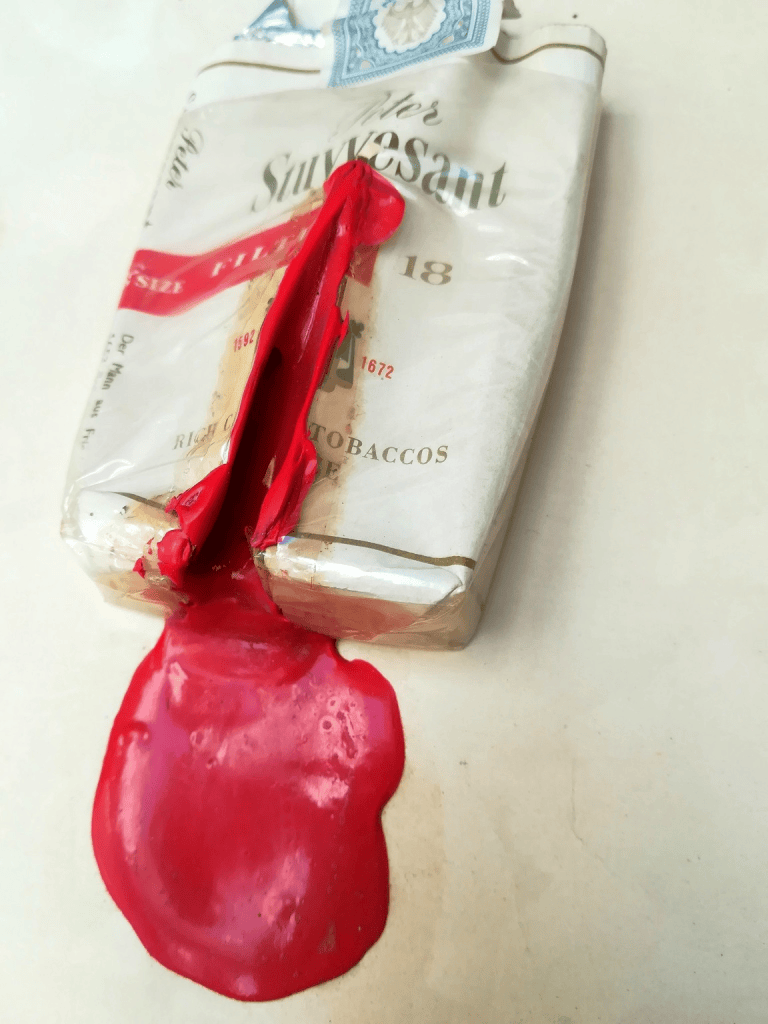
Photograph of the object “Untitled” — KH + CH Group (1972)
In 2026, this object is observed anew by a generative system.
The AI does not discover an original meaning within it. Nor can it reconstruct what my brother and I were thinking at the time.
Instead, it generates new possibilities for connection from the signs available to it.
One of them is the fictitious historical advertisement.
It is false.
It is plausible.
And precisely for that reason, it is epistemically revealing.
For suddenly we can observe how quickly open signs can be transformed into a closed story.
Perhaps, then, the epistemically most interesting use of generative AI does not lie in having it tell us what the world is like.
It may be more interesting to use it to observe how one possible world becomes an apparently self-evident world.
And, occasionally, how that self-evidence can be opened up again.

